Mastering the Honey Comb Vector Element Design for Modern Visual Communication
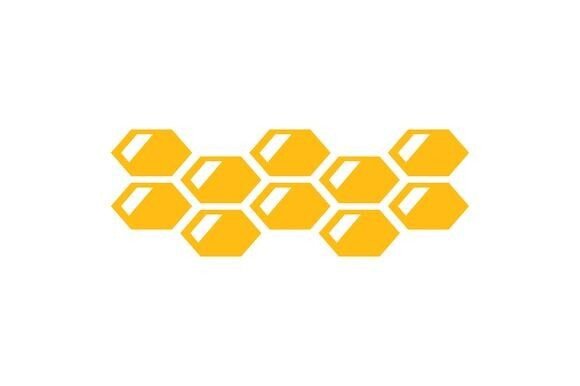
In the rapidly evolving landscape of digital design, geometric precision meets organic inspiration through the strategic use of hexagonal structures. The honey comb vector element design has emerged as a cornerstone motif for professionals seeking to convey connectivity, efficiency, and structural integrity. Unlike arbitrary shapes, the hexagon possesses inherent mathematical properties that resonate with human perception, suggesting stability and natural order. For creators, educators, and business owners alike, understanding how to leverage this specific geometric form can significantly enhance visual storytelling and brand identity.
The Geometric Advantage of Hexagonal Structures
The appeal of the honeycomb pattern is not merely aesthetic; it is rooted in biological and mathematical efficiency. In nature, bees utilize hexagons because they provide the most efficient way to divide a surface into regions of equal area with the least total perimeter. When translated into graphic design, this efficiency translates to visual clarity. A well-executed honey comb vector element design template allows designers to maximize space utilization while maintaining clean lines and balanced negative space.
Vector graphics, by definition, are scalable without loss of quality. This makes them ideal for applications ranging from tiny mobile app icons to massive billboard advertisements. When you combine the scalability of vector formats with the modular nature of hexagonal grids, you create a versatile asset library. Designers can expand or contract the grid, rotate individual cells, or isolate specific clusters without worrying about pixelation or resolution constraints. This flexibility is crucial for maintaining brand consistency across diverse media platforms.
Strategic Applications Across Industries
The versatility of hexagonal motifs means they are not confined to a single industry. Their application varies widely depending on the message the creator intends to send. Understanding these contextual nuances helps in selecting the right variation of the design for specific projects.
- Technology and Data Science: In tech branding, hexagons often represent nodes in a network, blockchain connections, or data clusters. The interlocking nature of the shape visually communicates security, integration, and complex systems working in harmony.
- Healthcare and Wellness: The organic origin of the honeycomb links it naturally to health, nutrition, and holistic wellness. Brands in this sector often use softer, rounded hexagonal vectors to evoke feelings of care, natural ingredients, and cellular health.
- Architecture and Engineering: Here, the focus is on structural strength. Sharp, precise hexagonal lines suggest durability, modern engineering, and innovative construction methods. Architects might use these elements in presentation boards to highlight modular building components.
- Educational Materials: Educators find honeycomb templates invaluable for organizing information. Each cell can hold a distinct fact, date, or concept, creating a visually engaging mind map that helps students retain information better than linear lists.
Selecting the Right Template for Your Workflow
Not all honey comb vector element design assets are created equal. When searching for or creating a template, several technical and aesthetic factors must be considered to ensure the final output meets professional standards. The choice of template can dictate the ease of customization and the overall impact of the design.
First, consider the modularity of the vector file. A high-quality template should allow for easy separation of individual hexagons. This enables designers to color-code specific sections, add icons inside particular cells, or create gradient flows across the grid. If the vectors are grouped improperly, editing becomes a tedious task of ungrouping layers, which can disrupt the workflow and increase project turnaround time.
Second, evaluate the stroke weight and corner radius. Some designs feature sharp, 60-degree angles that convey precision and rigidity. Others offer rounded corners, which soften the visual impact and make the design feel more approachable and friendly. The decision between sharp and rounded edges should align with the brand personality. A cybersecurity firm might prefer sharp edges to denote strict protection, while a community organization might opt for rounded edges to suggest inclusivity.
Customization Techniques for Unique Branding
To avoid the generic look associated with stock templates, customization is key. One effective technique is to break the grid. Instead of presenting a perfect, uniform honeycomb, consider removing certain cells to create white space or to highlight a central message. This asymmetry draws the eye and creates a dynamic composition that feels less static.
Another approach involves layering. By overlaying multiple honeycomb grids with varying levels of opacity and rotation, designers can create depth and texture. This method is particularly effective in background designs for websites or presentation slides, where the pattern needs to be present but not distracting. Using a honey comb vector element design template as a base layer allows for rapid experimentation with these complex effects without starting from scratch.
Enhancing User Experience Through Visual Hierarchy
Beyond aesthetics, hexagonal grids play a functional role in user experience (UX) design. The human eye naturally follows patterns, and the honeycomb structure provides a clear path for visual navigation. When used in interface design, hexagonal buttons or containers can guide users through a process step-by-step.
For example, in an onboarding flow for a software application, each stage of the setup could be represented by a hexagon. As the user completes a step, the corresponding hexagon changes color or fills in, providing immediate visual feedback. This gamification element leverages the satisfying nature of completing a pattern, encouraging user engagement and completion rates.
Furthermore, the compact nature of hexagons allows for higher information density without clutter. Compared to square or circular containers, hexagons tessellate perfectly, leaving no wasted space between elements. This is particularly useful for dashboards displaying multiple metrics or for portfolio galleries where maximizing screen real estate is essential.
Technical Considerations for Digital Implementation
When implementing these designs in web or app environments, performance optimization is critical. While vector files like SVGs are generally lightweight, complex honeycomb patterns with hundreds of individual paths can increase load times if not optimized properly. Developers and designers should collaborate to ensure that the code is clean and that unnecessary metadata is removed from the vector files.
Accessibility is another vital consideration. Decorative patterns should not interfere with screen readers or keyboard navigation. If the honeycomb structure contains meaningful content, such as text or icons, proper ARIA labels must be assigned to ensure that users with visual impairments can access the information. If the pattern is purely decorative, it should be hidden from assistive technologies to prevent confusion.
Color theory also plays a significant role in the effectiveness of the design. Hexagons share borders, meaning adjacent colors can influence each other through simultaneous contrast. Designers must test color combinations to ensure sufficient contrast ratios for readability and visual comfort. Using a monochromatic palette with varying shades can create a sophisticated, subtle effect, while complementary colors can generate high energy and draw attention to specific areas of the grid.
Future Trends in Geometric Design
As digital interfaces become more immersive, the role of geometric patterns like the honeycomb is expanding into three-dimensional spaces. With the rise of augmented reality (AR) and virtual reality (VR), flat vector designs are being extruded into 3D models. The hexagonal structure translates seamlessly into 3D environments, resembling cellular structures or futuristic architectural forms.
Moreover, the trend towards minimalism and neo-brutalism in web design continues to favor bold, geometric shapes. The honeycomb fits squarely within this aesthetic, offering a balance between order and creativity. As brands seek to differentiate themselves in crowded digital marketplaces, the strategic use of unique geometric motifs will remain a powerful tool for visual identity.
In conclusion, the honey comb vector element design is far more than a decorative trend. It is a functional, versatile, and psychologically resonant tool that serves a wide array of professional needs. From enhancing data visualization to strengthening brand identity, its applications are limited only by the creator’s imagination. By understanding the underlying principles of geometry, customization techniques, and technical implementation, professionals can harness the full potential of this timeless shape to create compelling, effective, and memorable visual communications.