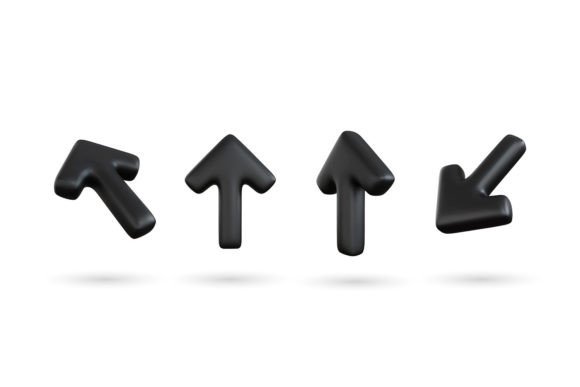
Integrating the Realistic 3d Arrow Vector Icon into Professional Design Workflows
In the fast-paced environment of digital content creation, visual clarity is not merely an aesthetic preference; it is a functional necessity. Whether you are designing a corporate presentation, developing a mobile application interface, or crafting marketing materials for a small business, the ability to guide the viewer’s eye effectively determines the success of your communication. This is where the Realistic 3d Arrow Vector Icon becomes an indispensable asset. Unlike flat, two-dimensional graphics that can sometimes blend into the background, a three-dimensional arrow provides depth, direction, and a tangible sense of movement. It serves as a universal signpost, helping users navigate complex information hierarchies with intuitive ease.
For professionals aged twenty to fifty who manage diverse projects—from freelancers juggling multiple clients to educators creating engaging course materials—understanding how to leverage high-quality vector assets is crucial. The value of this specific icon lies not just in its appearance, but in its technical flexibility. By incorporating a realistic 3D element into your toolkit, you elevate the perceived quality of your work while maintaining the efficiency required in modern workflows. This article explores how to integrate this asset seamlessly into your creative process, ensuring consistency, scalability, and professional polish across all your deliverables.
Understanding the Technical Advantage of Vector Formats
When acquiring digital assets, the file format is often as important as the visual design itself. The Realistic 3d Arrow Vector Icon is provided in two distinct formats: EPS 10 and JPG. Understanding the role of each is fundamental to efficient workflow management. The EPS (Encapsulated PostScript) file is the cornerstone of professional graphic design. As a vector file, it uses mathematical equations to define shapes rather than pixels. This means the image is resolution-independent. You can scale the arrow from the size of a favicon to the dimensions of a billboard without any loss in quality. There will be no pixelation, blurring, or jagged edges, regardless of how much you enlarge it.
This scalability is critical for entrepreneurs and marketers who need to repurpose content across various platforms. A single vector file can serve your website, your printed brochures, and your social media banners. In contrast, the included JPG file offers a ready-to-use raster image. While it cannot be scaled up indefinitely without quality loss, it is ideal for quick implementations where editing is not required, such as inserting the icon directly into a Word document, a PowerPoint slide, or an email newsletter. Having both files ensures you are prepared for any scenario, whether you need deep customization or immediate deployment.
Preparation and Compatibility in Your Design Stack
Before integrating the Realistic 3d Arrow Vector Icon into your project, it is essential to ensure your software environment is compatible. The EPS 10 format is widely supported by industry-standard vector editors. Adobe Illustrator and CorelDRAW are the primary tools recommended for editing these files. These applications allow you to access the individual components of the vector graphic. If your workflow relies on other software, such as Inkscape or Affinity Designer, verify their compatibility with EPS 10 files to avoid import errors.
Preparation also involves organizing your asset library. For productivity-minded users and publishers, maintaining a well-structured folder system for design resources saves significant time during tight deadlines. Store the EPS and JPG files in a dedicated directory labeled clearly, perhaps alongside other directional indicators or UI elements. This organizational habit ensures that when you are in the midst of a creative sprint, you are not wasting minutes searching for the right file. Furthermore, understanding the layer structure of the vector file before you begin editing can prevent accidental modifications to grouped elements. Take a moment to ungroup the objects in your vector editor to see how the shadows, highlights, and main body of the arrow are constructed. This insight allows for more precise adjustments later.
Practical Implementation Across Different Workflows
The versatility of the Realistic 3d Arrow Vector Icon allows it to fit into various stages of a project lifecycle. Consider its application in user experience (UX) design. When building a website or app, arrows are critical for onboarding processes, guiding new users through features, or indicating scroll directions. A realistic 3D arrow stands out against flat UI backgrounds, drawing attention to call-to-action buttons or next steps without appearing overly aggressive. Because the file is 100% vector, you can adjust the color scheme to match your brand guidelines perfectly. You might change the hue to align with a seasonal campaign or modify the shadow intensity to suit a dark mode interface.
In the realm of education and publishing, clarity is paramount. Educators creating digital slides or printable worksheets can use these icons to illustrate processes, timelines, or cause-and-effect relationships. The three-dimensional aspect adds a level of engagement that helps retain student attention. Similarly, bloggers and content creators can use the JPG version to break up text-heavy articles, visually signaling a transition between sections or highlighting key takeaways. The high-quality illustration ensures that even when compressed for web use, the icon remains crisp and professional.
For small business owners and marketers, these icons are invaluable in presentations and infographics. When pitching to investors or explaining a service workflow to clients, a clear visual path is essential. You can use the arrow to connect different stages of a business model canvas or to highlight growth trends in a chart. The ability to edit separate elements means you can curve the arrow, extend its length, or change its perspective to fit the specific layout of your slide. This level of customization ensures that your visuals look bespoke rather than generic, enhancing your credibility and professional image.
Editing and Customization Best Practices
To fully leverage the potential of the Realistic 3d Arrow Vector Icon, you must be comfortable with basic vector editing techniques. If you need to change the color, do not simply overlay a shape; instead, select the specific paths within the EPS file and adjust their fill properties. This preserves the integrity of the lighting and shading effects that give the arrow its realistic appearance. If you wish to remove certain elements, such as a reflection or a specific highlight, use the direct selection tool to isolate and delete those anchor points. Always keep a backup of the original EPS file before making significant changes. This practice allows you to revert to the default state if an edit does not yield the desired result.
Consistency is another key factor. If you are using this arrow in a larger set of icons or graphics, ensure that the lighting direction and shadow intensity match your other elements. Inconsistent lighting can make a design feel disjointed and amateurish. By adjusting the vector properties, you can harmonize the arrow with your existing visual language. For instance, if your brand uses soft, diffuse shadows, you may want to reduce the opacity of the shadow layer in the vector file. Conversely, for a bold, high-contrast look, you might deepen the colors and sharpen the edges.
Long-Term Value and Efficiency
Investing in high-quality vector illustrations like the Realistic 3d Arrow Vector Icon is a decision that pays dividends over time. Unlike low-resolution images that become obsolete as display technologies improve, vector files remain relevant indefinitely. As screens become sharper and print standards higher, your assets will continue to perform flawlessly. This longevity reduces the need for constant reacquisition of resources, streamlining your long-term operational costs.
Moreover, the ease of use associated with well-constructed vector files enhances overall team efficiency. When working with collaborators, providing them with editable EPS files allows for seamless handoffs. A designer can pick up where another left off, making adjustments without needing to recreate elements from scratch. This collaborative flexibility is essential in agency settings or when working with freelance partners. By standardizing your use of scalable, high-quality vectors, you establish a workflow that prioritizes precision, adaptability, and professional excellence.
Ultimately, the Realistic 3d Arrow Vector Icon is more than just a graphical element; it is a tool for clearer communication. By understanding its technical properties, preparing your workspace, and applying it thoughtfully across your projects, you enhance the effectiveness of your visual storytelling. Whether you are guiding a user through a digital interface or illustrating a complex business strategy, this asset provides the directional clarity and professional polish needed to succeed in today’s competitive landscape.